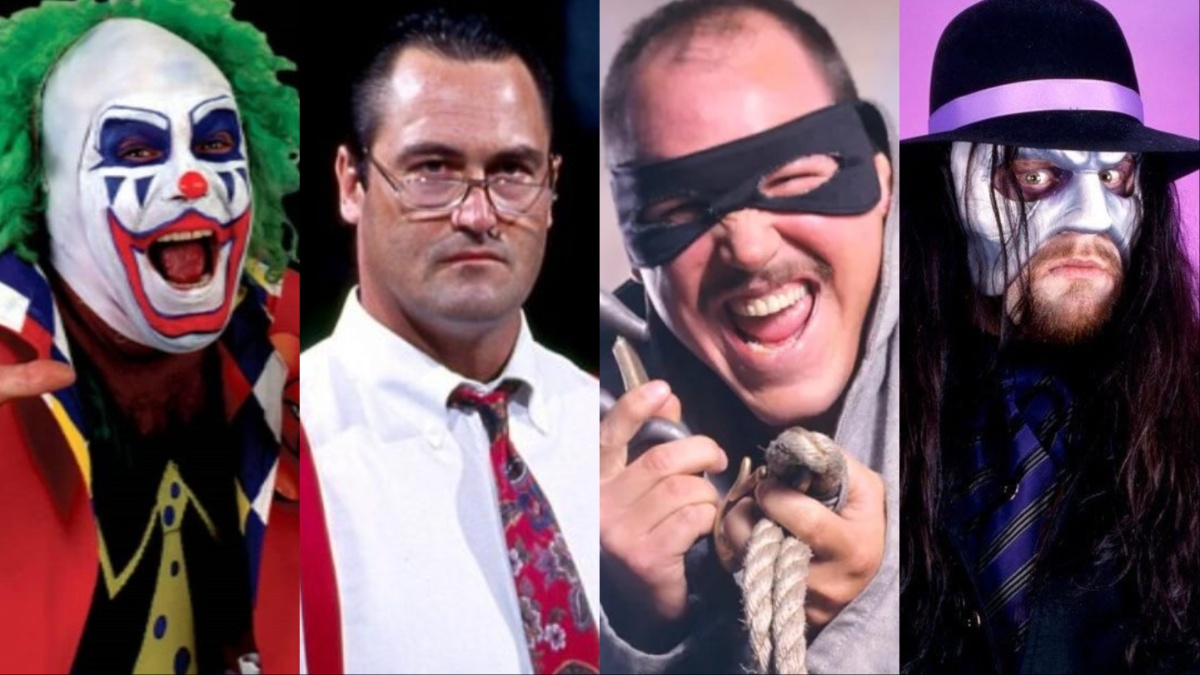
The Occupation Era: 10 Unforgettable “Cartoon” Gimmicks That Defined 90s WWF For professional wrestling fans who grew up in the early 1990s, the World Wrestling Federation (WWF) was less a simulated sport and more a living, breathing Saturday morning cartoon. Following the federal steroid trials and the departure of Hulk Hogan, the company shifted its target demographic toward a younger audience. In an effort to sell merchandise and create easily identifiable characters during a lean business period, Vince McMahon moved away from the gritty realism of the 1980s territories and embraced what is now affectionately known as the “Occupation Era.” During this period, it was not enough to simply be a wrestler. A performer needed a “day job” or a highly specific, often bizarre, persona to differentiate themselves. The roster was populated by hockey players, trash collectors, tax accountants, race car drivers, and evil dentists. While critics often deride this era for its lack of serious storytelling, it remains one of the most nostalgic periods in company history. These characters, played by incredibly skilled veterans who committed fully to the absurdity, provided some of the most memorable moments of the decade. Here are ten of the most iconic “cartoon” gimmicks that defined the 1990s WWF. 1. Doink the Clown (Matt Borne) Perhaps the most complex character of the entire era, Doink the Clown is often remembered as a goofy mascot, but his original incarnation was genuinely disturbing. Portrayed by second-generation wrestler Matt Borne, the original Doink was inspired by the Stephen King novel It and Jack Nicholson’s portrayal of The Joker. He was not a happy clown; he was a malicious prankster who derived pleasure from the pain of others. Borne, a legitimate tough guy with a reputation for being dangerous in the ring, brought a sinister edge to the character that transcended the “kiddie” concept. Backstage stories from the era suggest that Borne’s real-life personal demons and intensity fueled the performance. In an interview with The Hannibal TV, Borne explained the psychology: “I wanted to be a guy that, when you looked at him, you didn’t know whether to laugh or run. I wanted to be that split personality.” The character’s peak came at WrestleMania IX in Las Vegas, where a second Doink (played by Steve Keirn) appeared from under the ring to help Borne defeat Crush. The visual of two identical, evil clowns creating an illusion was a masterpiece of the era’s storytelling. While the character was later watered down into a babyface sidekick for Dink, the original 1993 run of “Evil Doink” remains a cult favorite for its psychological depth. 2. Irwin R. Schyster (Mike Rotunda) Few gimmicks garnered as much genuine “heat” (audience hatred) as Irwin R. Schyster, or I. R. S. Played by Mike Rotunda, a technically gifted wrestler who had previously teamed with Barry Windham, the character was an evil tax auditor from Washington, D. C. Paired with “The Million Dollar Man” Ted DiBiase to form “Money Inc.,” I. R. S. would enter the ring in a dress shirt, tie, and suspenders, grabbing the microphone to lecture the “tax cheats” in the audience about paying their fair share. The genius of the gimmick lay in its mundane nature. In a world of undead zombies and neon warriors, a tax collector represented the ultimate real-world villain for the adult parents in the crowd. Rotunda committed fully to the role, reportedly staying in character even during media appearances. Backstage, Rotunda was known for being fiscally responsible, making the casting ironic and perfect. The team of Money Inc. dominated the tag team division, holding the WWF Tag Team Championships three times. The image of Rotunda sweating through his dress shirt while applying an abdominal stretch is one of the definitive visuals of 1990s WWF television. 3. The Mountie (Jacques Rougeau) Jacques Rougeau had already found success as one half of The Fabulous Rougeau Brothers, but in 1991, he was repackaged as The Mountie. The character was a corrupt member of the Royal Canadian Mounted Police (RCMP) who utilized a battery-operated “shock stick” to torture his opponents after matches. He was managed by “The Mouth of the South” Jimmy Hart and famously screamed, “I am the Mountie!” to draw ire from American crowds. The gimmick was so effective-and controversial-that it led to a legitimate lawsuit. The real RCMP in Canada filed an injunction against the WWF, arguing that the character disparaged the reputation of their organization. Consequently, whenever the WWF toured Canada, the announcers were legally forbidden from referring to him as “The Mountie,” and he was simply introduced as Jacques Rougeau. The restrictions added a layer of legitimacy to the character’s notoriety. His brief run as Intercontinental Champion, which began after he defeated Bret Hart (who was wrestling with a high fever in the storyline), solidified him as a top-tier villain of the New Generation. 4. Repo Man (Barry Darsow) After the dissolution of the legendary Demolition tag team, Barry Darsow needed a new persona. He adopted the character of Repo Man, a sneaky, erratic thief who delighted in repossessing items from people who fell behind on their payments. Darsow transformed his look completely, wearing a Zorro-like mask, a trench coat with tire tracks on it, and sneaking to the ring in a crouched, prowling walk. The vignettes for Repo Man are legendary among nostalgia enthusiasts. They featured Darsow driving around in a tow truck, looking for cars to steal, and cutting frantic promos about how “it wasn’t yours to begin with!” Darsow’s commitment to the bit was absolute. In various shoot interviews, he has stated that he loved the character because it allowed him to show personality that he couldn’t display as the stoic Smash in Demolition. Although he was primarily used as a mid-card act to put over rising stars like Randy Savage and Tatanka, Repo Man remains one of the most recognizable “snapshot” characters of the era. 5. Papa Shango (Charles Wright) Before he was The Godfather or Kama Mustafa, Charles Wright was Papa Shango, a voodoo practitioner who carried a smoking skull and cast spells on his opponents. Debuting in 1992, the character was thrust into a main event feud with The Ultimate Warrior and Hulk Hogan almost immediately. The angle is infamous for a segment where Shango placed a “curse” on the Warrior, causing black goo to pour from the Warrior’s hairline during a promo. While the supernatural elements were criticized for being too campy even for the WWF, the character’s look was iconic. Wright shaved his head and painted his face with a skeletal design that looked terrifying on television. However, Papa Shango is perhaps best known for a massive blunder at WrestleMania VIII. During the main event between Hulk Hogan and Sid Justice, Shango was supposed to run in and break up the pinfall after Hogan’s leg drop. He missed his cue, forcing Sid to kick out of the legendary finisher. Despite the botched run-in and the short shelf life of the gimmick, the imagery of Papa Shango remains a staple of 90s wrestling nostalgia. 6. The Big Boss Man (Ray Traylor) While Ray Traylor debuted The Big Boss Man in the late 80s, the character reached its zenith of popularity in the early 90s. Originally a corrupt corrections officer from Cobb County, Georgia, who did the bidding of Slick and Ted DiBiase, Boss Man eventually turned babyface and became the enforcer of law and order for the fans. Wearing a stylized police uniform, he carried a nightstick and a pair of handcuffs, often handcuffing his defeated opponents to the ring ropes to beat them. Traylor was an incredibly agile big man for his size, capable of moving with a speed that defied his 300-plus pound frame. His feud with The Mountie in 1991, which culminated in a “Jailhouse Match” at SummerSlam where the loser had to spend a night in a New York City jail, was a highlight of the cartoon era. The vignettes showed Boss Man dragging the Mountie into a holding cell to have his fingerprints taken, perfectly encapsulating the episodic, sitcom-style storytelling Vince McMahon favored at the time. 7. Duke “The Dumpster” Droese (Mike Droese) Nothing exemplified the “Occupation Era” quite like Duke “The Dumpster” Droese. Debuting in 1994, Droese was literally a garbage man. He would carry a large, grey plastic trash can to the ring, which often contained the tools of his trade-or concealed weapons. The vignettes introducing the character showcased him complaining about the smell of refuse while claiming he would take out the trash in the WWF. Droese is perhaps best remembered for his feud with Jerry “The King” Lawler, which represented a classic class warfare dynamic: the blue-collar worker versus the aristocrat. The rivalry led to a memorable incident where Lawler shattered the trash can over Droese’s head, a moment that was replayed frequently on Raw. Backstage, Droese was involved in an infamous incident involving a prank. Reportedly, as a joke, someone (often rumored to be Mr. Perfect) defecated in Jerry Lawler’s crown. Droese, fittingly given his gimmick, was the one who ended up having to clean the locker room, though he was not the perpetrator. The “Dumpster” character remains a prime example of how literal the WWF creative team was during the mid-90s. 8. The Goon (Barney Gumble) In 1996, the WWF introduced “The Goon,” portrayed by veteran wrestler Barney Gumble (Bill Irwin). The character was a hockey enforcer who had been “kicked out of every league” for being too violent. He wrestled in a full hockey kit, including jersey, pads, and gloves. Most absurdly, he wore wrestling boots that were fashioned to look like ice skates, complete with fake blades on the bottom. To accommodate the gimmick, the wrestling mats were treated as if they were ice; The Goon would slide across the ring and “check” opponents into the turnbuckles. While the gimmick was short-lived and The Goon was primarily used as enhancement talent to put over other stars, the visual of a wrestler in “skates” attempting to grapple is one of the most surreal images of the New Generation era. The gimmick was a direct appeal to the aggressive nature of NHL hockey at the time but translated awkwardly to the squared circle. 9. T. L. Hopper (Tony Anthony) The “Occupation Era” would not be complete without the plumber. T. L. Hopper, portrayed by “Dirty White Boy” Tony Anthony, debuted in 1996. He wore a stained undershirt, suspenders, and carried his trusty plunger, which he affectionately named “Betsy.” The character’s vignettes were filmed in bathrooms, featuring Hopper unclogging toilets while delivering grimy metaphors about the wrestling business. Hopper’s signature move involved dragging his opponent to the corner, producing “Betsy,” and sticking the plunger into the wrestler’s face. It was a gimmick that relied entirely on “gross-out” humor, a precursor to the cruder humor that would define the Attitude Era a few years later. While T. L. 10. The Undertaker (Mark Calaway) The Undertaker is the anomaly on this list. While he fits the criteria of the “Occupation Era”-his gimmick was literally a western mortician-he is the only character from this period who not only survived but thrived for three decades. Debuting at Survivor Series 1990, the character was initially cartoonish, impervious to pain, and managed by the over-the-top Paul Bearer. However, unlike Repo Man or The Mountie, The Undertaker evolved. Mark Calaway protected the gimmick with a ferocity that no other performer matched. He rarely broke character, wore the trench coat and hat in public appearances, and adapted the style of the character as the audience’s tastes changed. What started as a gimmick that could have easily been a short-term novelty act became the most respected figure in the industry. The Undertaker serves as the ultimate proof that even in an era defined by plumbers and clowns, a performer with the right psychology and dedication could turn a cartoon concept into a legendary legacy.
https://wrestlingnews.co/features/plumbers-clowns-cartoon-gimmicks-defined-wwfs-new-generation-era/
From Plumbers To Clowns: 10 Cartoon Gimmicks That Defined The WWF’s New Generation Era