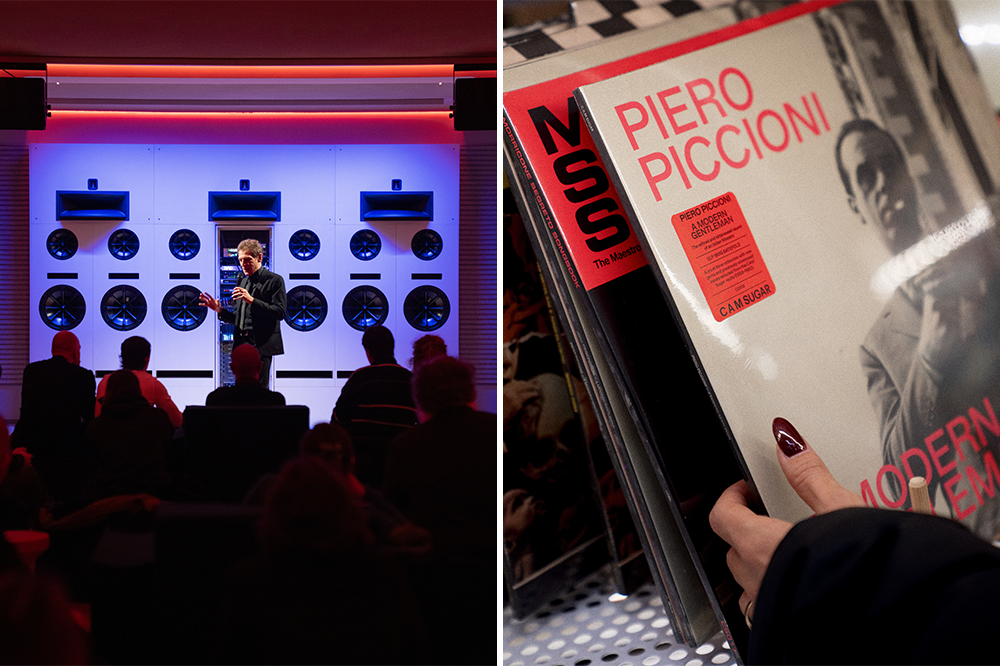
A maxim from Italian composer Ennio Morricone “Music must be able to say what words can’t” was a working thesis at Cam Sugar‘s inaugural SLAM Sounds Like a Movie festival this month in Milan. The new international festival, a collaboration between CAM Sugar and Triennale Milano, packed more than 30 events into the design museum’s galleries and performance spaces Nov. 14-16, drawing around 100 artists for screenings, talks, listening sessions, live gigs and DJ sets. Organizers have already committed to a second edition in 2026. For CAM Sugar, which celebrates the 65th anniversary of its catalogue this year, SLAM served as a way to boasts its vast library of more than 2, 500 Italian and French film scores from “La Dolce Vita” and “8½” to “Il Postino.” “The main quest in my job is letting the archive talk by itself,” says Andrea Fabrizi, CAM Sugar’s global archive and restoration lead, who curated several of the weekend’s most popular listening sessions. His programming leaned on a triptych of listening sessions, DJ sets and talks, a format he says lets audiences “have a complete view on that specific historic moment through the music” while hearing how it still vibrates in the present. Cam Sugar’s archives continue to fuel new work by filmmakers like Quentin Tarantino, Martin Scorsese and Wes Anderson, and to be sampled by artists ranging from Drake to Tyler, the Creator. Fabrizi describes the archive as a kind of “reading room before the room even exists,” where certain cues are built to fire directly at the body “kinetic charge, rhythm, the way the arrangement breaks” while others are psychological, designed for “a quiet space” and close listening. That split, he says, dictates whether a piece belongs on a dance floor, in a concentrated listening session or, ideally, both. Sometimes the magic is in the contrast: dropping something fragile “in the middle of a groove and watching people believe in it.” He points to Piero Piccioni’s score for “Il Caso Mattei,” which was screened over the weekend, as the sort of deep cut the archive is built to surface. The music, he argues, quietly rewrote the rules of film scoring in the early ’70s a blend of jazz intuition, political tension and near-spiritual minimalism whose grooves producers today would call experimental. SLAM’s first edition leaned heavily into Morricone’s legacy, including an exclusive preview of previously unreleased recordings from “Il Clan dei Siciliani” in a dedicated listening session, ahead of their December release on triple vinyl and double CD. The program also featured a tribute concert by longtime collaborator Enrico Pieranunzi and talks contextualizing the Maestro’s influence across contemporary cinema and sampling culture. On the French side of the archive, A&R and restoration lead Stéphane Lerouge spotlighted the diversity of CAM Sugar’s holdings from avant-garde experimental and pop to South American-inflected grooves. His passion project this year is the resurrection of “La Scoumoune,” a cult thriller score by François de Roubaix. Lerouge’s team located and digitized the original studio masters, allowing them to release, for the first time, an extended definitive version of the music, complete with de Roubaix’s own notes about his overdubbing process. For Lerouge, that recovery work underlines the universality of film music. He recalls Morricone telling him he never bothered learning foreign languages because “music language is universal,” a sentiment borne out by the cult followings these scores maintain in Japan and the U. S. decades after their initial releases. That universality was a recurring theme in SLAM’s marquee talks with working supervisors and composers. Mary Ramos, Quentin Tarantino’s longtime music supervisor, tell Variety her process often begins with what she calls a “yes-and playlist,” a collaborative back-and-forth with directors to calibrate what a film should sound like and, just as importantly, what it shouldn’t. Ramos’ long collaboration with Tarantino supplied some of SLAM’s juiciest anecdotes, including persuading the director, for “Django Unchained,” to commission new songs for the first time. She also recalled building that soundtrack around the twin themes of love and revenge, coaching John Legend to send Tarantino a cassette and handwritten letter and engineering a rare hybrid of James Brown’s “The Payback” with unreleased Tupac vocals, a cue that ended up scoring the film’s bloodiest shoot-out. If the festival leaned heavily into analog, it didn’t ignore the digital elephant in the room. Lerouge cautioned against directors’ over-reliance on temp playlists in the edit bay, calling it “a limitation in terms of imagination” that can box composers into copy-paste work. His plea to filmmakers was simple: trust composers, especially younger ones, the way Italian producers once trusted Morricone, Nino Rota and their peers to invent something new. Meanwhile, Nicolas Winding Refn, another panelist, argued for embracing technology while interrogating its economics. A self-described “big advocate” for tech, the director sees AI as just another tool in a creative ecosystem where data already shapes much of mainstream content. The real danger, he suggested, lies less in whether AI can write a decent score and more in the inequality that follows when “technology diminishes human hands,” hollowing out the financial ecosystem that supports working artists.
https://variety.com/2025/film/news/slam-cam-sugar-festival-milan-1236591806/
At Milan’s SLAM Festival, CAM Sugar Celebrated 65 Years of a Music Catalogue That’s Scored Thousands of Films