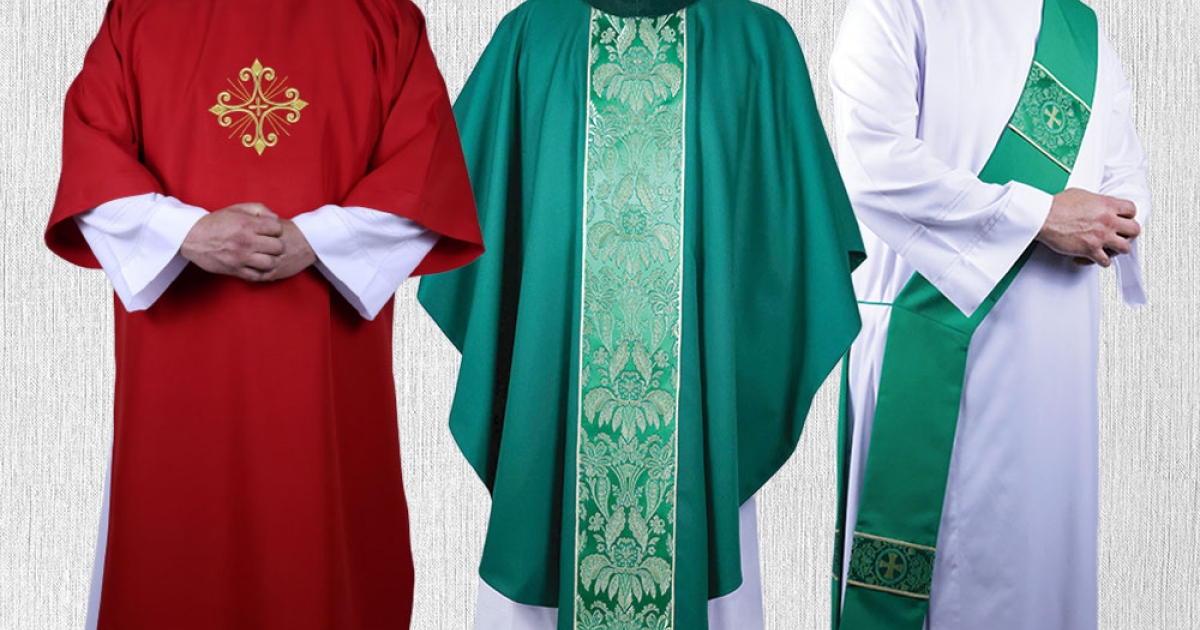
To the priest, what is worn at Mass is more than just clothing—it is a holy garment. Each layer is put on with intention and prayer. These vestments can reflect so much more than the liturgical season; they can embody a priest’s culture, specific spirituality, or charism.
Most of us might not think that a priest is especially concerned with wearing something “beautiful” for Mass. However, the enthusiasm priests have shown in response to custom vestments made by Maria Diplan is changing that perception.
Oratorian Father Johnni do Bonfim Silva, parochial vicar at St. Philip Neri Church in Fort Mill, emphasizes that vestments should always reflect the dignity of what is being celebrated. “Custom-made vestments, especially those made at home, are of utmost importance because they are made to my size, and I feel they are something special to wear at holy Mass. Whenever I put on my vestments, I remember the person who made them and pray for her. For liturgy, [it is] always the best,” he shared.
### The Cost and Craft of Custom Vestments
Having “the best” and appropriately sized vestments for liturgies isn’t necessarily a cheap endeavor. According to Maria, fabrics can cost up to $300 per yard, and only a few companies worldwide still have the machinery needed to produce specific fabrics in liturgical colors.
Maria has personally searched and traveled for the right fabrics, trims, and ribbons. Her home studio currently contains materials sourced from New York, England, Germany, and Italy. For embroidery, she collaborates with a company in Brazil that customizes logos and designs in size, color, and shape to suit the specific needs of each vestment.
In the end, these extraordinary pieces of artistic clothing—rich in symbols and colors, crafted with prayer, love, and a sense of “unworthiness,” as Maria puts it—are created in service to something sacred.
### Maria’s Story and Craftsmanship
Maria’s journey began in the Dominican Republic where she was born into a family with 10 children. Due to complications following childbirth, her mother, knowing she might not be able to raise baby Maria, asked her sister Enoelia to adopt her. Enoelia accepted, raised Maria in the Catholic faith, and involved her in a ministry of sewing vestments for parish priests.
Maria learned the art of sewing early on, starting with hand-embroidered stitches. Although her aunt Enoelia, now 87, taught her much, Maria has had to learn many skills along the way. There is no formal fashion design school for clerical attire, and the customization of each piece requires precision and attention to detail.
Now a parishioner at St. Philip Neri, Maria notes that priests have been open and honest about their preferences, providing feedback on everything from types of snaps and Velcro, to fabric choice and fit. This level of communication has helped her perfect her craft, leading many priests to spread the word about her custom-made vestments.
### Testimonials from Priests
Father Anthony Onoko, pastor at St. John the Baptist Church in Perryopolis, Pennsylvania, was one of those who sought Maria’s expertise. “A custom piece carries intention,” Father Onoko said. “It is crafted prayerfully, thoughtfully, and with a sense of purpose that readymade vestments simply cannot match. It becomes not just something to wear, but something that accompanies me in worship and a visible expression of sacred service to God. It reminds me of the dignity of the work I do and the responsibility I carry whenever I stand before God’s people.”
### Modern Embroidery and Global Collaboration
While embroidery no longer needs to be done by hand thanks to computer software and advanced machinery, Maria continues to work closely with designers to customize logos, emblems, crosses, and other religious symbols.
For example, when making stoles for the Rock Hill Oratory, Maria sent the Brazilian company the Oratorian logo. They created a digital embroidery file, allowing the priests of the Oratory to have stoles featuring their community’s emblem.
Fabrics, ribbons, trims, and embroidery designs come from various parts of the world, blending with each priest’s ethnicity, culture, and spirituality. This uniqueness makes custom vestments deeply appealing and a testament to the universality of the Catholic Church.
### Looking Ahead
Maria has named her company MD Ecclesiastics and hopes to launch a website soon to expand her services across the diocese. For now, her motto remains simple: “Whatever God wants.” She understands that for this ministry to grow, more people need to be trained and hired.
Maria humbly admits feeling “unworthy” because creating and sewing a garment worn by a priest when he celebrates Mass—and acts *in persona Christi*—is like clothing Christ himself.
—
### Glossary of Common Vestments
– **Deacon’s Stole:** A long, scarf-like vestment worn over the left shoulder and fastened at the waist, symbolizing service or being a messenger of the Church.
– **Chasuble:** A poncho-like outer vestment worn by a bishop or priest during Mass or ceremonies. A deacon’s chasuble includes stitched sleeves.
– **Alb:** A white vestment worn by those serving at Mass or ceremonies, tied at the waist with a cincture (cord).
—
### For the Altar
– **Corporal:** A square linen cloth on which the chalice and paten are placed during Mass.
– **Purificator:** A small rectangular cloth used to cleanse the chalice and paten after Communion.
– **Pall:** A stiffened square of linen used to cover the chalice.
—
**Learn more about the significance and artistry behind priestly vestments and how they deepen the beauty and reverence of the liturgy.**
https://themiscellany.org/creating-sacred-vestments-prayer-precision-intention-and-love