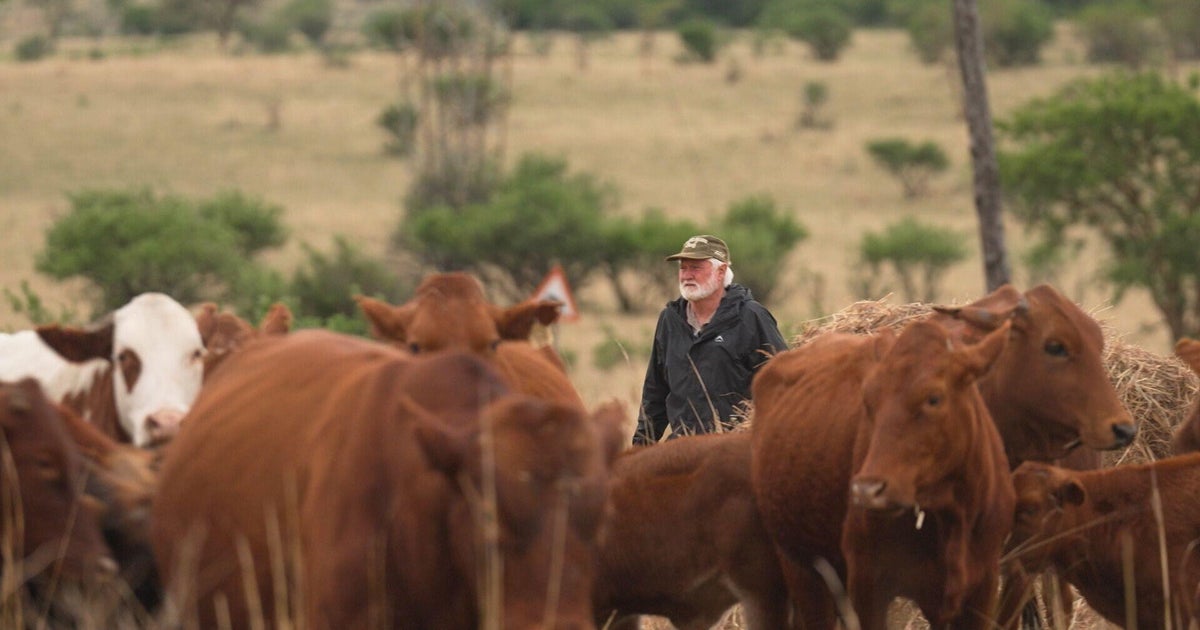
Darrel Brown’s father was attacked by robbers 10 years ago. Since then, three of his friends fellow South African farmers were murdered on their farms nearby. But Brown has no intention of leaving his home country, even as the Trump administration welcomes White South Africans to the United States as refugees. “I’m an African, and I’ve been burned by the African sun, and I’m not going anywhere,” he said. In February 2025, President Trump signed an executive order cutting off all aid to South Africa and announcing the “resettlement of Afrikaner refugees escaping government sponsored race-based discrimination.” Mr. Trump has claimed that White South Africans including Afrikaners, the 2. 7 million descendants of Dutch settlers who arrived on the continent 400 years ago are victims of a genocide and their land is being confiscated. But in South Africa, those claims are disputed. Max du Preez, an Afrikaans journalist and former newspaper editor, called his country’s government “corrupt” but said he’s never been discriminated against as a White South African. There are no large-scale killings of farmers and the government is not seizing their land, he said, as Mr. Trump has suggested. “It is not happening,” he said. “Donald Trump was fed this information, this link: farm murders, genocide. There is no such a thing. But it plays in Washington.” How claims of genocide originated In 1913, millions of Black South Africans were forcibly evicted from their land and lost their rights to it by law. Then in 1948, Afrikaners instituted apartheid, a brutal system of racial segregation and discrimination against the mostly Black population. Apartheid ended in 1994 when South Africans elected Nelson Mandela as president. In the years since, there’s been a growing Black middle class and a reduction in poverty. But controversial government efforts to redress inequalities have been plagued by corruption and cronyism. Many Afrikaners believe that they are now the victims of discrimination in post-Apartheid South Africa, and point the blame at affirmative action policies meant to redress centuries of discrimination. White supremacists in the U. S. and elsewhere have long amplified those beliefs, and have for years made false claims of a genocide in South Africa. In 2018 then-Fox News host Tucker Carlson began alleging that Afrikaner farmers were being killed and having their land seized. That got the attention of Mr. Trump who, at the time, tweeted about large-scale killings of White farmers in South Africa and government seizure of their land. After Mr. Trump signed the executive order promoting “the resettlement of Afrikaner refugees,” South Africa’s President Cyril Ramaphosa came to the White House to reset trade and economic relations. Mr. Trump showed several videos that the White House said were proof of violence targeting White farmers. “These are burial sites right here, burial sites, over a thousand, of White farmers,” Mr. Trump said during the meeting. What Afrikaners say about genocide claims 60 Minutes correspondent Anderson Cooper traveled to the spot Mr. Trump was talking about: a lonely, pothole-filled road not far from Darrel Brown’s farm in the rolling hills of KwaZulu-Natal province in the southeast of South Africa. Brown is the one who placed the crosses seen in the video shown by Mr. Trump on the road. He put them there on the day of his friends’ Glen and Vida Rafferty’s funeral, the couple who were murdered during a 2020 robbery. “It definitely wasn’t a burial site,” Brown said. “Those crosses were there for less than 48 hours. It was purely an avenue of crosses that we planted there in honor of commercial farmers in South Africa that had lost their lives.” Brown kept the crosses in his shed, then brought them out again in 2024 for the funeral of his best friend, Tollie Nel, who was murdered on his farm. Nel was killed in front of his wife, Rene, as he tried to fight off burglars. Their son, Theunis, was tied up while the burglars stole cash and guns. No one has been arrested. Theunis now runs the farm and carries a weapon with him almost all the time. The Nels have hired private security guards and fortified their property with electric fences and cameras. They say they can’t rely on the country’s ineffective and overwhelmed police to keep them safe. Despite losing her husband, Rene Nel doesn’t feel Mr. Trump’s use of the word “genocide” is appropriate. “Not what I know as a genocide, not what I’ve seen as a genocide, not what I’ve heard of what a genocide is,” she said. She views it as a crime of opportunity by people who knew there was money and firearms on the farm. Crime in South Africa South Africa is one of the most dangerous countries in the world. The murder rate is seven times that of the United States’. According to police, more than 25, 000 people were murdered in the country in 2024. It’s estimated 37 people were killed on farms. According to agricultural economist Wandile Sihlobo, the overwhelming number of farmers and those working on farms in South Africa are Black. “The White farmers may have– a bigger part of the proportion of income,” said Sihlobo, “but the vast majority of people operating the farms in South Africa are Black.” He adds that Black farmers and farmworkers are victims of violence, too. In the first quarter of 2025, South African police recorded six murders on farms; five of the victims were Black. Nhlanhla Zuma, a Black farmer, said he was robbed repeatedly on his farm. He sold it after a September 2024 incident when a group of men shot at him and broke into his house. “There are a lot of Black farmers that are attacked, and their voices are not out,” he said. South Africa remains one of the world’s most economically unequal countries. About 44% of the Black population lives in poverty compared to 1% of Whites. That poverty is the country’s biggest driver of crime, according to Johan Kotze, an Afrikaner who is head of South Africa’s largest agricultural organization. Kotze traveled to Washington last February to explain to administration officials what he says is happening in the country. He was shocked when they asked him about White genocide. “The first thing I said, ‘I’m as Afrikaans as what you can get. I grew up Afrikaans,'” Kotze said. “‘And I never witnessed that.'”.
https://www.cbsnews.com/news/is-there-genocide-afrikaner-south-africa-60-minutes/
On South Africa’s farms, there’s push back against claims of genocide