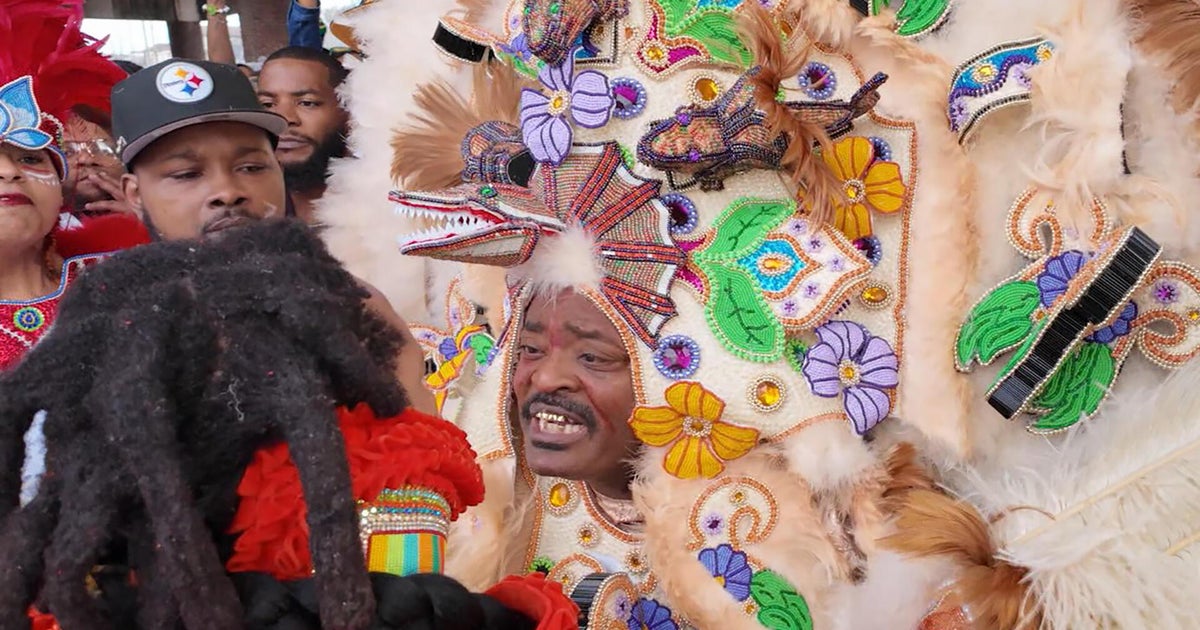
On Mardi Gras day in New Orleans, if you’re lucky or in the know, you can see a dazzling procession of Mardi Gras Indians, or Black Masking Indians, marching through the streets, resplendent in suits that are covered in beads, feathers, and rhinestones. “The makers of the suits work on them all year long for the display on Mardi Gras day,” correspondent Bill Whitaker told 60 Minutes Overtime. “And they are elaborate, and meticulous, and colorful, and beautiful.” The suits worn by big chiefs, the leaders of the so-called tribes, are often the most detailed and impressive, and that’s by design. But the big chiefs aren’t the only revelers who get dressed up. On Mardi Gras morning, Whitaker and the 60 Minutes team met Elenora Brown, better known as Big Queen Rukiya, who masks with the Golden Eagles tribe. Queen Rukiya revealed her stunning sea green suit, covered in feathers, intricate bead work, a banner emblazoned with the words “America,” and rhinestone alligators hiding in the sleeves. “I tell the people the story of the alligator, and how we lived, and how he took care of us, and fed us. clothes, shoes. And he is a sacred symbol of Louisiana,” the big queen told Whitaker. When the tribes set out to parade on Mardi Gras day, they don’t have a pre-determined route, but there is a goal in mind: to find another tribe and square off in mock battle, pitting big chief against big chief to determine the “prettiest.” Typically, each tribe also has members that can spot opposing tribes on their route, send signals back to the big chief and control the crowds: a spy boy, a flag boy and a wild man. “The spy boy is at the head of the group, and he’s out looking for these other tribes,” Whitaker told 60 Minutes Overtime. Whitaker spoke with J’Wan Boudreaux, a spy boy for the Golden Eagles, on Mardi Gras day 2026. “I’m pretty much the eyes of the tribe,” he told Whitaker. “I’m the first person that runs into anybody. So if anybody’s comin’ with trouble, I’m supposed to sense that and know what’s coming in contact with our tribe.” When a spy boy wants to communicate with the rest of the procession, which can sometimes stretch for blocks, they use secret hand signals. Marwan Pleasant is a flag boy for the Golden Eagles. His job is to communicate between the spy boy and the big chief. Using the flag, which has the tribe’s name on it, “I would send a signal to the back to let the big chief know what’s going on,” he told Whitaker. When two tribes confront each other, a wild man clears the space for the big chiefs to have their showdown and nothing can get in between them. Askia Bennett is a wild man for the Young Seminole Hunters tribe. “I’m opening a big old hole. If I swing something If I whatever I need space. I need space for my big chief and my tribe,” he told Whitaker. “Do you have to have a little bit of wild in you to be the wild man?” Whitaker asked. “Definitely, yes, sir,” Bennett said. When the two big chiefs square off, things can get a little heated. “They confront each other, talking a lot of trash. it’s like, ‘You think you look good? I know I look better,” Whitaker explained. “It’s warfare. It’s basically a battle. So, we’re competing to see who’s the prettiest Indian or who have the better suit,” Walter Fair, a spy boy for the Young Seminole Hunters tribe told 60 Minutes. Fair and Bennett said the crowd ultimately judges who is the “prettiest,” in their words. “The ‘oohs’ and the ‘ahs’ tells,” Fair told 60 Minutes. “What everyone told us is that this is mostly about being there for the community,” Whitaker told 60 Minutes Overtime. Historians believe the tradition dates back to the 1800s. And according to Mardi Gras Indian lore, it’s said to be a sign of respect for the Native Americans who gave refuge to enslaved Black people who had escaped servitude in New Orleans. It also became an outlet for the Black community that historically wasn’t allowed to march on New Orleans’ main Mardi Gras parade routes. Joseph Boudreaux Jr. recently became a big chief of the Young Eagles. After years of masking with his father, he formed his own tribe. “When we say we’re out there to look pretty, it’s really for the community. back in the day, people of color weren’t able to actually participate in the carnival that New Orleans, you know, posted on post cards and everything, the parades,” Boudreaux told Whitaker. “So to give them something to celebrate, we create these suits. On Mardi Gras day they’re saying to the working-class and Black communities in New Orleans, ‘Hey, you’re special as well. We’re doing this for you. You are the reason we are here,'” Whitaker told Overtime. Whitaker asked Big Queen Rukiya what her role meant to her. “It’s an honor to carry this title. Because other little girls get to see me and women get to see me,” she told Whitaker. “That is the best love in the world, because they don’t know me, like, know me, know me. They know me for being a big queen. They always gonna see me in a beautiful light. When I see that they feel better, I feel better.” This video above was produced by Will Croxton. It was edited by Nelson Ryland. Jane Greeley was the broadcast associate.
https://www.cbsnews.com/news/the-anatomy-of-a-mardi-gras-showdown-60-minutes/
The anatomy of a Mardi Gras showdown