general

Coinbase Targets RWA, DeFi & AI As Key Investment Areas For 2026 ⋆ ZyCrypto

The post Coinbase Targets RWA, DeFi & AI As Key Investment Areas For 2026 ⋆ ZyCrypto appeared com. Crypto exchange Coinbase highlighted prominent sectors it plans to invest in next year. This follows a surge in retail adoption and institutional capital into stablecoins, infrastructure, and Artificial Intelligence (AI). Coinbase Backs Nine Market Sectors The venture capitalists’ arm of Coinbase is targeting nine areas for fresh investment throughout 2026. In a recent blog post, the exchange explains the need to answer the “what to build next” questions as more protocols begin to emerge. Coinbase Ventures is keen on tokenization and RWA, specialized exchanges, trading terminals, decentralized finance (DeFi) expansion, proof of humanity, AI and robotics, etc. This will expand adoption in these areas, reinforcing its bullish stance on the market’s future. This year, stablecoin growth attracted Coinbase, with analysts pointing to how its infrastructure reshaped payments. Speed and cross-border settlements were also at the center of mainstream adoption. A cross-section of investors is seeking new exposure in trading assets. Coinbase Ventures plans massive RWA scale to onboard exotic assets on-chain and to improve the trader base with cryptocurrencies. Tokenization highlights the recent traditional influx to the sector that has been avoided for more than a decade. Advertisement “With renewed interest in on-chain real-world assets (RWAs), investors are seeking new forms of exposure, and perpetuals, crypto’s most proven trading product, offer a structurally faster and more flexible path than tokenization. Enabled by recent improvements in perpetual DEX infrastructure, RWA perpetuals create synthetic exposure to off-chain assets through perpetual futures contracts.” Traditional investment poured into tokenization in recent months with fresh global partnerships. Several governments, including the United States, are currently developing regulatory frameworks, while others have advanced to pilot stage. Aside from tokenization, artificial intelligence is a top priority for both developers and executives. Markets are keen on integrating the tools needed for expansion.

general

NYDIG Reveals the Real Reason Behind Bitcoin’s Sharp Drop! “The Reasons That Brought Bitcoin to Its ATH Are Now Dropping It!”

The post NYDIG Reveals the Real Reason Behind Bitcoin’s Sharp Drop! “The Reasons That Brought Bitcoin to Its ATH Are Now Dropping It!” appeared com. Leading cryptocurrency Bitcoin (BTC) experienced significant declines in October and November, most recently falling to the $80,000 level last week due to massive liquidations and selling pressure. However, with the expectation of a FED interest rate cut increasing again, Bitcoin started the new week on the rise. Bitcoin, which reached as high as $88,000 in the last 24 hours, has retreated to just below $87,000. It had fallen to around $81,000 on Friday. The Factors That Made Bitcoin Rise Are Now Falling! While the FED’s decreasing interest rate expectations, macroeconomic uncertainty, decreasing liquidity and increasing selling pressure were cited as the reasons for the decline, NYDIG research head Greg Cipolaro listed the main factors that caused the decline. At this point, NYDIG’s Greg Cipolaro said that the primary factors that triggered Bitcoin’s rise are now triggering the price drop. According to Greg Cipolaro, Bitcoin’s recent drop to $81,000 is due to market dynamics rather than investor confidence. The analyst explained that the fundamental drivers behind the 2024-2025 Bitcoin rally are now contributing to the price drop. At this point, Cipolaro stated that spot Bitcoin ETF inflows and Institutional Digital Asset Treasury (DAT) demand had pushed Bitcoin to record levels, but now they have led to a decline in price. He noted that liquidations in early October caused a reversal in ETF inflows, a sharp decline in the DAT (DAT) premium, and a decrease in stablecoin supply, indicating that funds were leaving the system. According to the analyst, spot Bitcoin ETFs, once a key success factor this cycle, have now become a factor hindering Bitcoin’s growth. Furthermore, declining global liquidity and macroeconomic news continue to impact Bitcoin. NYDIG noted that spot BTC ETFs recorded net outflows for six consecutive trading days, a sharp contrast to the large inflows seen in the.

general

Wormhole launches Solana listing platform Sunrise DeFi

The post Wormhole launches Solana listing platform Sunrise DeFi appeared com. Sunrise will go live as Solana’s new day-one listing platform, giving major assets a direct path to launch with ready liquidity. Summary Sunrise creates a single route for new assets to launch on Solana with day-one liquidity. Monad’s MON is the first token supported, with trading live today. The platform uses Wormhole’s NTT framework to streamline cross-chain movement. Wormhole Labs has introduced Sunrise, a Solana-native listing gateway that lets major new assets launch on Solana with immediate day-one liquidity, starting with Monad’s MON token. Announced on Nov. 23, Sunrise is a dedicated liquidity route for new assets entering Solana. Solana gets a new gateway for day-one listings The platform builds on Wormhole’s (W) Native Token Transfer framework, allowing assets issued on external chains to arrive on Solana (SOL) without wrapped tokens, multi-bridge flows, or fragmented liquidity. Introducing Solana’s new one-day listing platform. The new way major assets list and become tradable on @Solana with deep liquidity on day one. On Monday, MON becomes tradable natively across Solana DeFi. Learn more below: pic. twitter. com/vvGRBmnGmw Sunrise (@Sunrise_DeFi) November 23, 2025 Sunrise is designed as a “day-one listing platform,” matching Solana’s need for a unified entry point where new tokens can become tradable across decentralized exchanges within hours. Sunrise noted that assets can now “arrive on Solana immediately with ready and liquid markets,” positioning the platform as the standard path for future major listings. The rollout coincides with Monad’s mainnet activation on Monday, Nov. 24. MON will become the first asset supported by Sunrise, enabling users to deposit MON from Monad to Solana and begin trading it against USDC, SOL, and other Solana assets on day one. How Sunrise works and its role in Solana DeFi Historically, many major launches often occurred on other chains first, pulling capital away from Solana and delaying.

general

UNI Price Prediction: $7.50 Target by December 2025 as DeFi Recovery Accelerates

The post UNI Price Prediction: $7. 50 Target by December 2025 as DeFi Recovery Accelerates appeared com. Lawrence Jengar Nov 22, 2025 16: 20 UNI price prediction points to $7. 50 by December 2025, with analysts forecasting $7. 89-$8. 75 targets amid DeFi recovery and technical oversold conditions. UNI Price Prediction Summary • UNI short-term target (1 week): $6. 75 (+10. 8%) • Uniswap medium-term forecast (1 month): $7. 25-$7. 89 range• Key level to break for bullish continuation: $6. 92 (SMA 7 resistance) • Critical support if bearish: $4. 74 (immediate support level) Recent Uniswap Price Predictions from Analysts The latest UNI price prediction data from November 18, 2025, shows a remarkably bullish consensus among major crypto analysts. CoinGape leads with the most aggressive UNI price target of $8. 60-$8. 75 by end of November, driven by heightened DeFi adoption and protocol upgrades. Meanwhile, CoinCodex projects a more conservative $7. 89 target by December 21, representing a 25. 85% upside from current levels. The Uniswap forecast convergence around the $7. 89-$8. 75 range suggests institutional confidence in UNI’s recovery potential. All three predictions share medium confidence levels, indicating cautious optimism rather than speculative enthusiasm. This measured approach aligns with current market conditions where UNI trades 49. 83% below its 52-week high of $12. 13. UNI Technical Analysis: Setting Up for Bullish Reversal Current Uniswap technical analysis reveals a classic oversold setup with significant recovery potential. At $6. 09, UNI sits near the lower third of its Bollinger Bands (0. 35 position), historically a zone where strong rebounds occur. The RSI reading of 43. 24 positions UNI in neutral territory, providing room for upward momentum without hitting overbought conditions. The MACD histogram shows -0. 1008, confirming recent bearish momentum, but this creates an attractive contrarian setup. UNI’s position below all major moving averages (SMA 7: $6. 92, SMA 20: $6. 75, SMA 50: $6. 66) indicates oversold conditions that typically precede significant bounces in quality DeFi tokens. Volume analysis supports the reversal thesis, with.

general

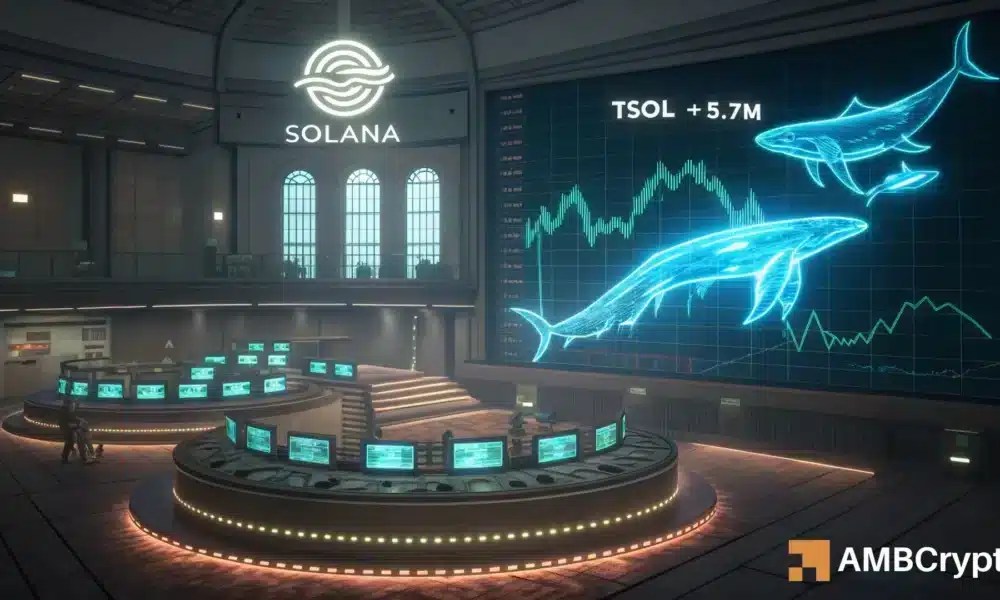
TSOL sees strongest ETF performance: Will Solana reach $170?

The post TSOL sees strongest ETF performance: Will Solana reach $170? appeared com. Journalist Posted: November 22, 2025 Key Takeaways Why is TSOL seeing strong inflows? TSOL recorded $5. 7M in daily inflows as institutions rotate into newly listed Solana ETFs for fresh exposure. What supports Solana’s bullish setup? SOL’s $120 demand zone remains intact, and whale accumulation is rising, strengthening prospects for a potential reversal toward $170. After its debut back in the 20th of November, 21Shares’ TSOL has quickly become the strongest performer among Solana spot ETFs, recording $5. 7 million in inflows over the last 24 hours. The daily figure outpaced every other listed Solana ETF and pushed the total cumulative daily ETF inflows to $10. 58 million, pointing to a fresh wave of institutional interest in the asset. Concurrently, the inflows also arrive as Solana [SOL] continues to sit at a critical price area, with the $120 demand zone still acting as a key support level. Despite recent volatility, the price continues to react strongly around that zone, making the zone a key price zone for the altcoin’s next move. The resistance zone at $170 could be the next target if a successful reversal occurs. Solana long-term holders have continued to add more SOL at current levels despite the recent price drop. The whale activity aligns with the broader trend of institutional accumulation over the last few weeks. The developments indicate an increased confidence on the anticipated potential trend reversal for SOL. As observed from the previous pattern, retail traders usually follow the whales, and it could be a matter of time before they chip in.

general

Why the Exchange Wants to Go Public Now

The post Why the Exchange Wants to Go Public Now appeared com. Cryptocurrency exchange Kraken’s choice to move ahead with a confidential IPO filing, just days after securing an $800 million raise, shows an exchange trying to capitalize on market momentum while U. S. regulators edge toward clearer crypto rules. The timing surprised some market watchers as the company’s recent capital raise implied a strong private-market valuation and provided substantial runway. But the IPO move fits a broader trend playing out across crypto, according to seasoned securities attorney Megan Penick of Dorsey & Whitney. “As digital asset treasury companies are increasingly seeking to access the U. S. capital markets . crypto exchanges, such as Kraken, are also seeking to access greater liquidity through initial public offerings,” she said in an email to CoinDesk. For Kraken, liquidity is only part of the equation. As the industry emerges from a multi-year regulatory fog, exchanges are trying to position themselves for the next growth inflection. “Regulators are moving to bring greater clarity to crypto regulation, with a bipartisan proposal aiming to bring BTC, ETH and crypto exchanges clearly within the CFTC’s regulatory purview,” Penick said. If that shift materializes, a U. S.-listed Kraken could operate with a degree of regulatory certainty previously unavailable, boosting appetite among institutional investors. Penick added that Kraken could complete its offering in “six months or so,” assuming a typical review cycle and updates to financials. But the agency only recently reopened after being shuttered for nearly six weeks, creating a backlog of review filings. That means Kraken’s debut may stretch into 2026. The timing of Kraken’s IPO is also intriguing. Crypto exchanges Bullish (whose parent company Bullish Global is also the owner of CoinDesk) and Gemini both went public in recent moves with shares popping on open. But now, the crypto market is embarking on a corrective phase with bitcoin BTC$85,533. 71 dropping from.

general

Bitcoin Market Dip Driven by OG Holders Selling to TradFi Buyers

TLDR CryptoQuant CEO states Bitcoin’s recent dip reflects OG holders selling to TradFi players. Bitcoin’s price drop due to short-term holders’ panic selling and long-term holders rotating. Traditional finance and institutional players inject liquidity into Bitcoin despite the dip. Bitcoin’s limited supply and strong demand point to long-term upward price potential. The recent dip in [.] The post Bitcoin Market Dip Driven by OG Holders Selling to TradFi Buyers appeared first on CoinCentral.

general

Can Strategy Survive A 90% Bitcoin Crash? Saylor Says Yes

Michael Saylor is explicitly telling markets that Strategy (MSTR) has been built to withstand a Bitcoin crash that would wipe out almost every other leveraged player in the ecosystem. In an interview with Grant Cardone streamed live on November 14 the Strategy executive chairman drew a clear theoretical stress line for the company’s balance sheet and stated that even a catastrophic move lower in BTC would not force him to liquidate the core position. Strategy Can Eat A 90% Bitcoin Collapse Asked how far Bitcoin would have to fall before MicroStrategy faces real danger, Saylor answered with balance-sheet math rather than rhetoric. He pointed to roughly eight billion dollars of debt and tens of billions in equity value tied to Bitcoin, and then set the threshold: Bitcoin, he said, “would have to fall 90% from here for us to be sort of collateralized, to be one-on-one.” Related Reading: Bitcoin Indicator Sounds Buy Alarm For The First Time Since March Return To $110K Soon? Even at that point, his first response would not be to sell BTC into a collapsing market. Instead, he described equity holders as the primary buffer. “We probably would dilute the equity, and so it would be bad for the equity,” he told Cardone, before stating the hierarchy even more bluntly: “The equity is going to be a loser.” By contrast, he framed liquidation as essentially off the table in any realistic bear market scenario. When Cardone pressed him on whether Strategy could be forced to unwind its Bitcoin position, Saylor answered flatly: “We’re not going to liquidate.” The bond side only enters the conversation in an almost total-loss scenario. “If Bitcoin fell to zero tomorrow forever, then the bonds would default,” Saylor said. He then compressed the entire risk profile into a single line: “If you think Bitcoin is going to go to $10,000, I think we’re good. If you think Bitcoin’s going to a dollar tomorrow forever, then yeah, the bonds would default.” Related Reading: How Low Can Bitcoin Price Go? JPMorgan Points To A Key Threshold That framing makes the structure very clear. Equity is a highly levered, high-beta claim on Bitcoin that can be diluted if necessary. Bondholders and holders of MicroStrategy’s various credit-like instruments only face real danger if Bitcoin essentially dies as an asset class. The 4-Year Cycle Is Dead Saylor also used the interview to distance himself from one of the core narratives many Bitcoin traders still live by: the four-year halving cycle. His view is that the mechanical supply cut may have helped shape earlier phases of Bitcoin’s monetization, but it is no longer the dominant driver of price in a market now intertwined with global macro and institutional flows. “I don’t believe in four-year cycles anyway,” Saylor said. “I never believed in the- I think that they might have had some credence in the first 12 years.” He then shifted straight to scale and order of magnitude. After [the last] halving, the reduction in new supply is on the order of a couple hundred BTC a day. In his translation, “225 Bitcoin a day get taken out of the supply after the next halving, that’s twenty million dollars or twenty-two million dollars of buying.” Against a spot and derivatives complex that can see tens or even hundreds of billions of dollars in notional volume in a single session, that number, he argued, is marginal. “Trust me, twenty million dollars of buying. is not even a third-order issue at this point,” he said. What matters now? “The dynamics in the market are much more that Jerome Powell thinks he wants to hold interest rates higher for longer. It’s macroeconomics. It’s political. It’s structural. When IBIT’s derivatives market went from $10 billion to $50 billion, it did that in four weeks. [.] It’s the actions of the mega finance actors that are determining the future of Bitcoin right now, Saylor said. At press time, Bitcoin traded at $95,624. Featured image from YouTube, chart from TradingView. com.


general

BlackRock’s IBIT offloads $463M in Bitcoin, largest outflow on record

The post BlackRock’s IBIT offloads $463M in Bitcoin, largest outflow on record appeared com. Key Takeaways BlackRock clients sold $463 million in Bitcoin in a single day, the highest outflow recorded. The outflow reflects institutional risk management amid volatile market conditions. Investors pulled $463 million from BlackRock’s IBIT Bitcoin ETF on Friday, representing the largest single-day outflow on record for the product. The massive selloff reflects institutional investors reducing their exposures amid heightened volatility. BlackRock clients appear to be rebalancing their portfolios by scaling back Bitcoin positions as market conditions shift. US-listed spot Bitcoin ETFs recorded net outflows of around $492 million on November 14. Source:.